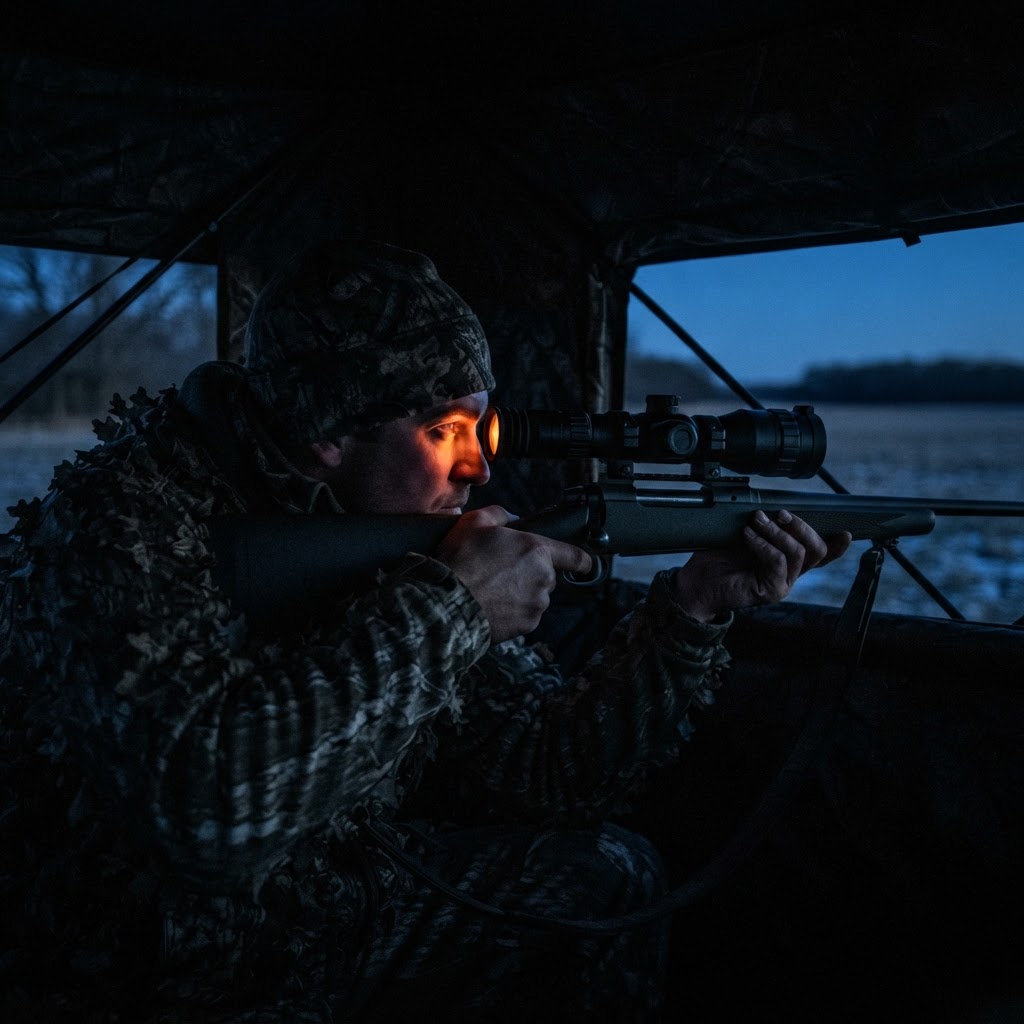
Four thousand dollars buys the whole range at once: a first thermal at $875, the value all-rounder at $1,755, and a 640 with a built-in laser rangefinder at $3,295. Every scope below is one we carry, quoted at the manufacturer's published specification from our catalog — prices and stock move, so confirm on the product page.
What actually matters under $4,000
At this ceiling every scope you can buy is decent, so the differences come from five things rather than one:
- Sensor class. 256 / 320 / 384 / 640. This sets how far out you can still tell a coyote from a calf, and it matters more than magnification.
- Sensor sensitivity (NETD, in millikelvins). Lower is better. At 15 mK the image holds up on a mild, humid night; at 35 mK it starts to flatten when the temperature spread between animal and ground is small.
- Objective lens. A 19–25 mm lens keeps the scope light and wide; 35 mm is the all-rounder; 50 mm and longer buys standoff at the cost of field of view.
- Whether a laser rangefinder is built in. Past your zero distance this converts holdover from a guess into a number, and it is worth more than an extra step of digital zoom.
- The mount, the power and the warranty. A scope that loses zero or dies at midnight is not cheap at any price. AGM publishes a 36-month warranty on this line, while ATN and SIG publish 60 months at the top end of the range.
Quick comparison: our picks under $4,000
| Pick | Price | Sensor | Objective | NETD | Weight | LRF | Warranty | Best for | | --- | --- | --- | --- | --- | --- | --- | --- | --- | | AGM Rattler V2 256 2.5-20x | $875 | 256×192 | 19 mm | ≤35 mK | 1.06 lb | No | 36 mo | First thermal on a real budget | | AGM Rattler V2 320 3.5-28x | $1,095 | 320 | 25 mm | ≤20 mK | ~1.1 lb | No | 36 mo | Best budget step-up | | AGM Rattler V2 384 3-24x | $1,755 | 384×288 | 35 mm | ≤20 mK | 1.13 lb | No | 36 mo | Best all-round value | | SIG SAUER Echo RQ35 | $2,099 | 384×288 | 35 mm | ≤20 mK | 1.2 lb | No | 60 mo | Longest warranty at mid-price | | AGM Varmint V2 LRF 384 3-24x | $2,195 | 384×288 | 35 mm | ≤20 mK | 1.14 lb | Yes | 36 mo | Ranging on a mid budget | | AGM Clarion 384 dual 25/50 mm | $2,195 | 384×288 | 25 mm + 50 mm | ≤20 mK | 1.65 lb | No | 36 mo | One scope, two fields of view | | ATN THOR 6 3.5-28x | $2,525 | 384×288 | — | ≤15 mK | 1.89 lb | No | 60 mo | Farthest published detection | | AGM Rattler V2 640 2-16x 35 mm | $2,695 | 640×512 | 35 mm | ≤20 mK | 1.06 lb | No | 36 mo | Cheapest route into 640 | | ATN THOR 6 LRF 3.5-28x | $2,965 | 384×288 | — | ≤15 mK | 1.83 lb | Yes | 60 mo | Ranging, sensitivity and warranty together | | AGM Rattler V3 384 3.5-28x 35 mm | $2,995 | 384×288 | 35 mm | ≤15 mK | 1.13 lb | No | 36 mo | Best image quality per dollar | | AGM Adder V2 LRF 384 4-24x | $2,995 | 384×288 | 35 mm | ≤15 mK | 1.83 lb | Yes | 36 mo | Rangefinder with a bright display | | AGM Rattler V2 640 2.5-20x 50 mm | $3,295 | 640×512 | 50 mm | ≤20 mK | 1.13 lb | No | 36 mo | Long shots in open country | | AGM Varmint V2 LRF 640 2-16x | $3,295 | 640×512 | 35 mm | ≤20 mK | 1.14 lb | Yes | 36 mo | 640 and ranging together | | AGM Clarion 640 dual 35/60 mm | $3,295 | 640×512 | 35 mm + 60 mm | ≤20 mK | 1.65 lb | No | 36 mo | Dual field of view at 640 | | ATN THOR 6 Mini 640 3-24x | $3,845 | 640×512 | — | ≤18 mK | 1.16 lb | No | 60 mo | Compact body, long-range sensor |
The full reviews
AGM Rattler V2 256 2.5-20x 19 mm — $875
Check the live price and stock →
The cheapest thermal scope here that is still a real hunting tool.
A 256×192 sensor and a 19 mm objective give a wide, light scope for timber, barns and feeders where the shot is close. At 1.06 lb with a 36-month warranty, it is the honest entry point if you want to learn thermal without spending a grand.
Pros
- Under $1,000 with an actual warranty, not a toy-grade device
- Wide field of view makes it easy to scan cover
- Light and short, so it mounts like a normal scope
- 50 Hz refresh, so moving animals do not smear
Cons
- Identification falls off quickly past 100–150 yards — this is a detection and close-range tool
- The ≤35 mK sensor flattens on mild, humid nights
- No rangefinder and no ballistic calculator
Buy it if your shots are inside 150 yards, or you are adding a second scope for close cover.
AGM Rattler V2 320 3.5-28x 25 mm — $1,095
Check the live price and stock →
The budget step-up that fixes the two things the 256 cannot.
The 25 mm objective buys reach over the 19 mm, and the ≤20 mK rating is a meaningful jump in contrast over the 35 mK entry model — that is what separates a usable image on a warm night from a gray soup.
Pros
- 20 mK sensitivity at a four-figure price
- 3.5–28x covers close cover through to open field
- Same 36-month warranty and light body as the rest of the V2 line
Cons
- Still a sub-400 sensor, so digital zoom softens quickly past 3x
- No rangefinder
- The jump to a 384/35 mm costs about $650 and is worth saving for if your shots run long
Buy it if you want the most scope you can get for just over $1,000.
AGM Rattler V2 384 3-24x 35 mm — $1,755
Check the live price and stock →
Best all-round value on this list, and the scope most hunters should buy.
This is the combination everything else gets judged against: a 384×288 detector, a 35 mm objective and ≤20 mK sensitivity, in a 1.13 lb body. AGM publishes a 1,800-yard detection figure for it, which is a detection figure — judge it on how far you can identify, which in practice is the 200–250 yard band.
Pros
- 384 pixels put real detail on the reticle instead of a blob
- 35 mm objective is the versatile middle: wide enough to scan, long enough to shoot
- 20 mK keeps contrast on mild nights
- 36-month warranty, and it is in stock at this price
Cons
- No rangefinder at $1,755 — that step costs another $400–450
- 1.13 lb plus mount is noticeable on a light rifle
- Digital zoom past ~4x adds pixels, not information
Buy it if you hunt hogs, predators and varmints between 100 and 250 yards, which is most people.
SIG SAUER Echo RQ35 — $2,099
Check the live price and stock →
The alternative worth considering on warranty alone.
A 384 sensor behind a 35 mm objective at ≤20 mK, in a 1.2 lb body — and SIG publishes a 60-month warranty where AGM publishes 36. If you keep a scope for a decade, that difference is real money.
Pros
- 60-month warranty at a mid-tier price
- 384 / 35 mm / 20 mK is the proven all-round combination
- 3.5–28x gives a wide usable magnification band
Cons
- Roughly $340 more than the AGM equivalent for the same core specification
- No rangefinder at this price
- SIG does not publish a detection range for this model, so you cannot compare that figure — compare NETD and objective instead
Buy it if you value the longer warranty and a different reticle ecosystem over saving a few hundred dollars.
AGM Varmint V2 LRF 384 3-24x 35 mm — $2,195
Check the live price and stock →
Best way to get a rangefinder without leaving the mid budget.
Same 384 / 35 mm / 20 mK core as the Rattler, with a built-in laser rangefinder. For predator and varmint work where animals hang up at 200–300 yards, the LRF does more for hit rate than any amount of extra zoom.
Pros
- 20 mK sensitivity plus ranging for under $2,200
- 36-month warranty
- Turns holdover from an estimate into a number
Cons
- 1.14 lb before the mount, and the rangefinder housing adds bulk
- 384 pixels still limit identification at the far end of the range
- The 640 version costs $1,100 more — decide whether pixels or ranging matter more to you
Buy it if you shoot past your zero distance regularly.
AGM Clarion 384 dual 25/50 mm — $2,195
Check the live price and stock →
Two scopes in one body: 25 mm for scanning, 50 mm for the shot.
Dual magnification via two focal lengths is genuinely useful — a wide field of view to find the animal, a narrow one to place the shot — and it is the only way to get 50 mm reach at this price without buying a separate spotter.
Pros
- 25 mm and 50 mm in one unit, switched instantly
- 384 sensor with ≤20 mK sensitivity
- Covers scanning and long shots without a second optic
Cons
- 1.65 lb is the heaviest mid-priced pick here
- Two optical paths mean more to go wrong, and more glass to keep clean
- No rangefinder
Buy it if you want one scope for both roles and do not mind the weight.
ATN THOR 6 3.5-28x — $2,525
Check the live price and stock →
The longest published detection figure under $4,000, plus a 60-month warranty.
ATN rates this 384×288 at 3,000 yards — a detection figure far beyond the rest of the field — and pairs it with ≤15 mK sensitivity and a 60-month warranty. The 1.89 lb body and app-driven menu are the trade.
Pros
- 15 mK sensitivity for strong contrast on mild nights
- 60-month warranty at $2,525
- Ballistic calculator and video recording built in
Cons
- 1.89 lb is heavy on a light rifle
- The menu and app workflow take real learning time
- 384 pixels with a short native focal length means the published 3,000-yard figure is detection, not identification — be honest with yourself about that
Buy it if you scan wide open country and want the longest reach and warranty at this price.
AGM Rattler V2 640 2-16x 35 mm — $2,695
Check the live price and stock →
The least expensive way into a 640 detector.
A 640×512 sensor behind a 35 mm objective for what most brands charge for a 384. Nearly three times the pixels of a 384 means real identification at distance and detail that survives zoom.
Pros
- Cheapest 640 on our shelf, and it is in stock
- Identification distance is the reason to buy it — coyote versus calf stops being a guess
- Same 1.06 lb body and 36-month warranty as the V2 line
- ≤20 mK sensitivity
Cons
- 2-16x is a narrower magnification band than the 384 version's 3-24x
- The 15 mK 384 scopes above show slightly better contrast on a mild night — pixels versus sensitivity is a genuine trade
- No rangefinder
Buy it if identifying animals at distance matters more to you than the last increment of contrast.
ATN THOR 6 LRF 3.5-28x — $2,965
Check the live price and stock →
The most complete scope under $3,000: sensitivity, ranging and a 60-month warranty.
≤15 mK sensitivity, a built-in laser rangefinder and a 1920×1080 display in one unit. This is the pick for someone who does not want to choose between a clean image and knowing the distance, and who keeps equipment long enough for the warranty to matter.
Pros
- 15 mK contrast and a built-in rangefinder
- 60-month warranty
- 3.5–28x band with a 1920×1080 display
- Ballistic calculator pairs with the rangefinder
Cons
- 1.83 lb is the heaviest scope on this list
- The app-driven menu and firmware workflow take learning time
- 384 pixels rather than 640, so identification at distance still has a ceiling
Buy it if you want ranging and long-term coverage in one purchase, and you accept a heavier body.
AGM Rattler V3 384 3.5-28x 35 mm — $2,995
Check the live price and stock →
The best image quality per dollar on this list.
≤15 mK sensitivity, a 35 mm objective and a 1920×1080 OLED display — the display matters as much as the detector, because it is what your eye actually looks at. This is the scope for someone who wants a superb 384 image rather than a compromised 640.
Pros
- 15 mK sensitivity plus a high-resolution display makes it visibly sharper than 20 mK units
- 3.5–28x band with 384 pixels is comfortable across distances
- 36-month warranty, 1.13 lb
Cons
- No rangefinder for $2,995
- Still 384 pixels — the 640 scopes at the same price win on identification at distance
- Price puts it within reach of the 640 models, so know which you value
Buy it if contrast and display quality matter more to you than raw pixel count.
AGM Rattler V2 640 2.5-20x 50 mm — $3,295
Check the live price and stock →
The long-shot pick: most pixels behind the longest lens.
A 640 detector with a 50 mm objective and a 2,600-yard published detection figure is the combination for open country — bean fields, cut corn, prairie — where animals are 300 yards out and the question is whether the shape is worth a stalk.
Pros
- 640 pixels behind 50 mm is the longest usable reach here
- 2.5–20x with a fixed 50 mm means detail holds as you zoom
- Still a 1.13 lb body
- 36-month warranty
Cons
- Narrow field of view: scanning thick cover with this is work
- 20 mK rather than 15 mK
- No rangefinder at $3,295
Buy it if your hunting is long, open and deliberate.
AGM Varmint V2 LRF 640 2-16x 35 mm — $3,295
Check the live price and stock →
Everything in one unit: 640 detector, rangefinder, 36-month warranty.
If you want to stop choosing between pixels and ranging, this is the answer — 640 identification plus a laser rangefinder in a single scope, and the 2-16x band keeps the field of view usable for scanning.
Pros
- 640×512 detector and built-in LRF
- Lighter than the Adder equivalent at 1.14 lb
- 36-month warranty, 20 mK sensitivity
Cons
- $600 more than the 640 without the rangefinder
- 2-16x tops out lower than the 3-24x scopes; zoom is not its strength
- 20 mK, not 15 mK
Buy it if you want one scope that does detection, identification and ranging without compromise in the field.
Budget thermal imaging scopes: what $1,200 or less actually buys
Budget does not mean unusable — it means a narrower job description. Under about $1,200 you are buying a detection-and-close-range tool: 256 to 320 class detectors, 19–25 mm objectives, and sensitivity between 20 and 35 mK. Used within that envelope they are excellent value; used across a bean field they will disappoint you, and not because anything is wrong with them.
Budget comparison table
| Scope | Price | Sensor | Objective | NETD | Warranty | Field of view | The honest job | | --- | --- | --- | --- | --- | --- | --- | --- | | AGM Rattler V2 256 2.5-20x 19 mm | $875 | 256×192 | 19 mm | ≤35 mK | 36 mo | Widest | Timber, feeders, barns — inside ~100–150 yd | | ATN THOR 6 Mini 2-16x 256×192 | $985 | 256×192 | 19 mm | ≤18 mK | 60 mo | Wide | Same job with better contrast; check stock before ordering | | AGM Rattler V2 320 3.5-28x 25 mm | $1,095 | 320 | 25 mm | ≤20 mK | 36 mo | Medium | The best-balanced budget pick — 150–200 yd identification |
How to buy in this tier without wasting money
- Buy sensitivity before pixels. Between two budget scopes, take the lower NETD. A 320 at 20 mK reads better on a warm night than a 256 at 35 mK, and on a mild, humid evening that gap is the whole experience.
- Do not buy zoom. Every budget scope claims 20x-plus, and all of it past about 3x is digital — it enlarges pixels rather than resolving them. Judge the objective lens and the detector instead.
- Hold money back for the mount and a second battery. A budget scope on a bad mount is worse than no scope. A one-piece mount and a spare cell cost $100–200 and matter more than the difference between two similarly priced optics.
- Check the warranty length. It ranges from 36 to 60 months in this tier, and it is the cheapest insurance you will ever buy on a thermal.
- Accept the ceiling. A budget scope finds animals; it does not always identify them at distance. If your shots regularly exceed 200 yards, save for a 384 or 640 instead of spending twice.
How we picked these
Every figure above is the manufacturer's published specification, taken from the product record in our own catalog, and every pick is a scope we actually carry. We do not invent detection ranges: where a maker does not publish one we leave the cell empty instead of estimating. Prices and stock move with the manufacturer, so confirm both on the product page before you buy, and treat the "best for" column as a starting point for your own terrain rather than a verdict.
Compare any two of these side by side
Spec sheets only take you so far. Our comparison tool stacks any two scopes against each other — resolution, objective, NETD, weight, rangefinder, price — so the final call is made with the numbers in front of you.
Compare any two scopes side by side →
Sources
- AGM Global Vision — manufacturer specifications for the models named above
- ATN — manufacturer specifications for the models named above


